Thursday, September 18, 2014

Western Bluebird

Continuing my alphabetical series on my "5" Star Photos we come to the Western Bluebird. The Western and Mountain Bluebird ranges are nearly identical (the Western halve of North America). But the Western Bluebird has a bright orange breast (duller in the female) while the Mountain Blue is pretty much all blue. The photo of the male came from Mount Lemmon, Arizona while the photo of the female was taken near Joshua Tree National Monument in California.

Western Bluebird Male

Western Bluebird Female


Wednesday, September 17, 2014

Water Lily

It seems like quite a while ago that I was doing a series on my "5" Star Photos. But we are nearing the end -- on "w's" anyway. So I will try to get the series completed within the next couple of weeks. Today, not a bear, not a caribou, not an elegant trogon or a tri-colored heron, but a simple water lily. 

Sometimes simple is good:

Water Lily

Tuesday, September 16, 2014

Sweetwater Wetlands and Christopher Columbus Lake

I had a late start yesterday, so didn't arrive at Sweetwater Wetlands until 11:00 -- or more importantly until it was 104 degrees. The consequence was a very quiet visit. I did see a Green Heron fly in a weed bed and a Belted Kingfisher heading somewhere cooler. Probably my best photos were a Savannah Sparrow and a couple of Mexican Mallards:

Savannah Sparrow

Mexican Mallard

Juvenile Green Heron
 I didn't fare any better at Christopher Columbus Lake. The few birds there were stayed pretty much deep inside the trees where they were foraging. The best there was this Yellow Rumped Warbler:

Yellow Rumped Warbler

Saturday, September 13, 2014

Huachuca Canyon: Always Good Birding

I went again to Huachuca Canyon looking for the Sinaloa Wren and now the newly reported (one time) Prothonotary Warbler. And, again no luck. However, as is usually the case I didn't come home without some photos, including a couple very nice photos like the ubiquitous Wilson's Warbler and Painted Redstart. Even though often seen I thought those two in particular turned out well:

Wilson's Warbler
Painted Redstart
Black Throated Gray Warbler
Nashville Warbler
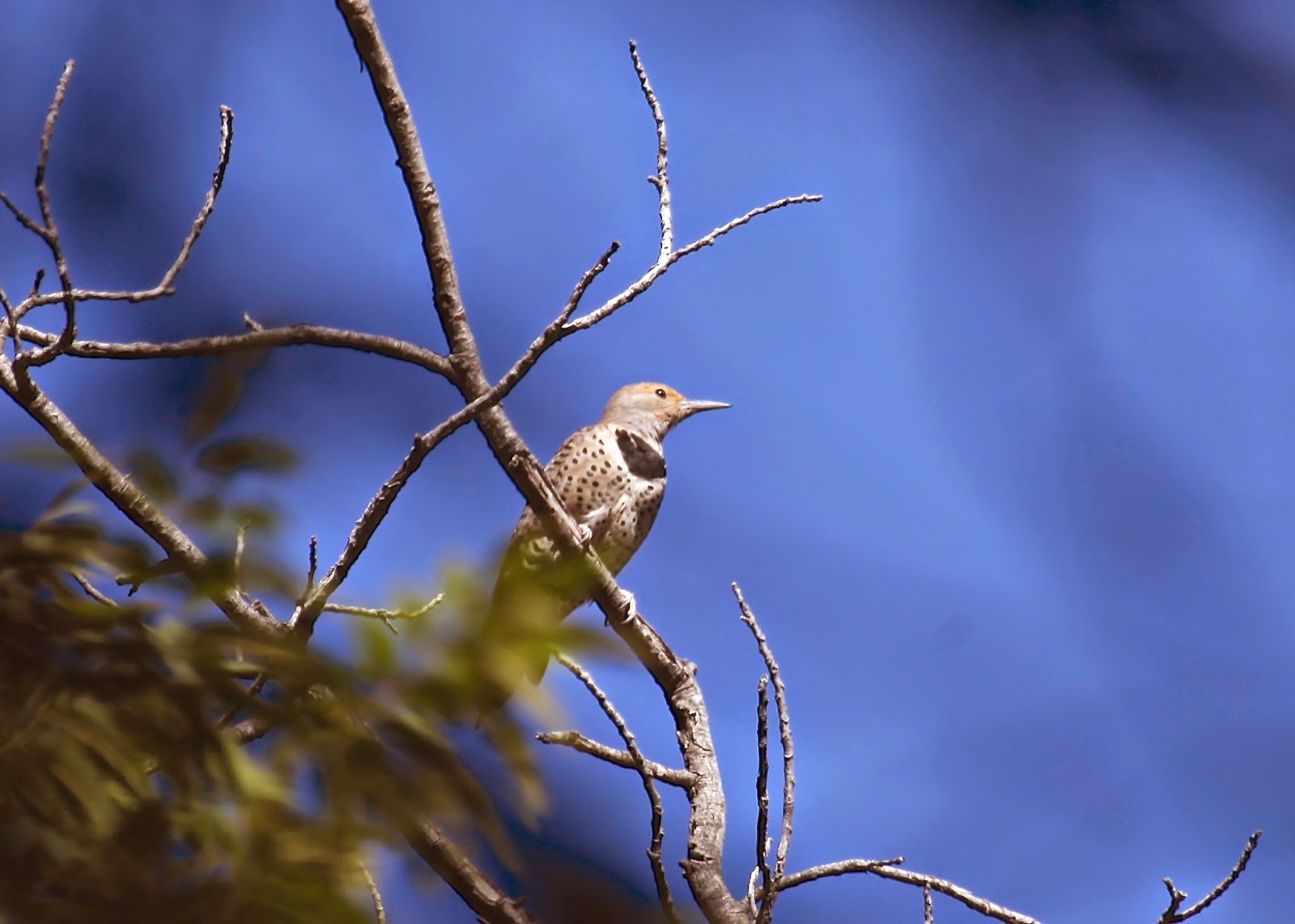
Gilded Flicker
California Sister
unidentified butterfly
Pipevine Swallowtail

Wednesday, September 10, 2014

Birding Christopher Columbus Park, Tucson

Christopher Columbus Lake  is on the West Side of Tucson and a recreational area for fishing, picnicking, kite flying, and remote controlled flying machines. It gets quite a bit of use, so is hardly "wilderness." 

Yet it provides a haven for birds -- and birders. And, since it gets a lot of people, birds are a little more "friendly" and can be approached if done slowly and quietly.

There are two essential areas: 1) the lake, and 2) a riparian area created by a small creek coming from the north side of the lake. 

The lake is the most reliable place in Tucson for finding and photographing Great Blue Herons and Great Egrets. There are often Black Crowned Night Herons as well.


The riparian area attracts warblers, vireos, with the occasional rarity like the Northern Waterthrush. It is often quite birdy and certainly well worth exploring if going to the lake.

Here are some photos from yesterday's trip to CCL.

Great Egret

Great Blue Heron

Roadrunner

Wilson's Warbler

Sunday, September 7, 2014

Randolph Park Birding

Yesterday I headed down to Randolph Park to see if I could find the reported Northern Waterthrush. As is often the case, the reported "rare" bird wasn't found, but there were other interesting birds to see and photograph:

Green Heron
Black Crowned Night Heron

Sharp Shinned Hawk

Wilson's Warbler
1st Year Wilson's Warbler
MacGillivray's Warbler

Drab Bell's Vireo

Saturday, September 6, 2014

The Bats are Back - And I'm Not Talking Baseball

Every year about this time migratory bats arrive in Tucson. How do I know? My hummingbird feeders tell me so. 

We have 8 hummingbird feeders which get changed every two - three days (depending mostly on the weather, not because they are empty). But all that changes in late August or early September when the bats drain the hummingbird feeders every night.

It is the Mexican long-tongued bat from Venezuela, Central America, and Mexico that arrives for dinner at our feeders. In nature they feed on nectar and pollen from agaves and other plants. Their tongues can extend up to a third of their body length which allows them to reach nectar deep inside an agave or cactus blossom. The young are born well-furred for additional warmth in the cool mountain canyons where this species roosts.

A couple years ago I sat up patiently with my camera waiting for them to show up. Wasn't until about 11:00 pm, but I was able to get a few photos: